
UAE VAT Changes Effective from 1 October 2026: What Businesses Need to Know

The UAE VAT rate remains at 5%, but this does not mean that the VAT framework has remained unchanged. Since 1 October 2026, Cabinet Decision No. 149 of 2026 has introduced several important amendments that change the way businesses should approach VAT recovery, supplier verification, cash payments and the classification of certain transactions.
For many businesses, the impact will be practical rather than purely technical. Finance teams may need to carry out additional checks before recovering input VAT, procurement teams may need to collect more information from suppliers, HR teams may need to review the treatment of employee accommodation, and businesses dealing with cross-border services or high-value assets may need to reconsider their existing VAT procedures.
A separate but related development also took effect on the same date under FTA Decision No. 13 of 2026. It introduces more detailed requirements for businesses to verify certain suppliers and transactions before claiming input VAT. In practice, simply holding a valid tax invoice may no longer be enough in every case.
This article explains the main changes in practical terms and highlights what UAE businesses should now review in their VAT procedures.
The nine changes at a glance
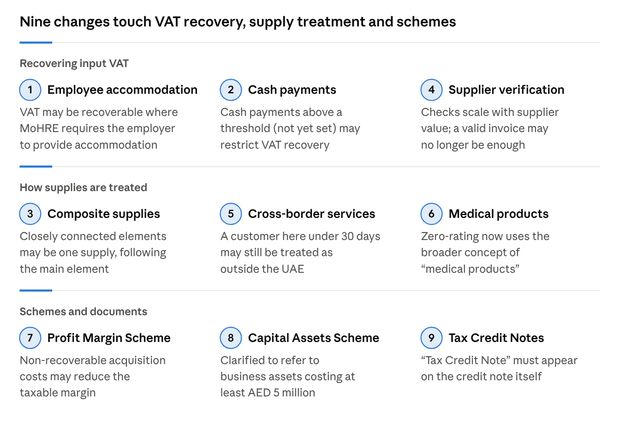
Each card matches the numbered section below.
1. Employee accommodation: clearer rules on VAT recovery
Except in certain situations, VAT on goods or services provided mainly for an employee’s personal benefit is not recoverable. The amendments clarify when employee accommodation falls within an exception.
Before. Employee accommodation could already qualify for an exception in some cases, but it was not always clear when it should be treated simply as an employee benefit and when it was provided because the employer was required to do so.
From 1 October 2026. If an employer is required to provide accommodation under a decision or directive issued by the Ministry of Human Resources and Emiratisation (MoHRE), the related VAT may be recoverable, provided the normal VAT recovery conditions are met.
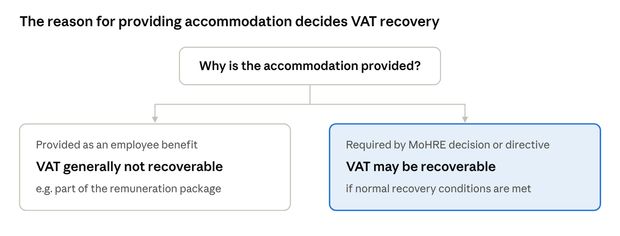
Why this matters. Businesses should be able to explain why accommodation is being provided, and keep documents showing whether it forms part of the employee’s remuneration package or whether the employer is legally required to provide it.
2. High-value cash payments: how you pay may affect VAT recovery
One of the new rules concerns payments made in cash and introduces a potential link between the method of payment and the right to recover input VAT.
Before. The payment method did not normally determine whether VAT could be recovered. If the usual VAT recovery conditions were satisfied, paying a supplier in cash or by bank transfer generally produced the same VAT result.
From 1 October 2026. A new Article 54(3) restricts VAT recovery where the value of the supply exceeds a prescribed threshold and the payment is made, or is intended to be made, in cash.
The monetary threshold has not yet been set. A separate Ministerial Decision is expected to determine the amount and the detailed rules, so businesses should not assume that every cash payment is affected.
Why this matters. The way a supplier is paid may now affect whether the related VAT can be recovered. Businesses that make significant cash payments should review their payment procedures and monitor the forthcoming Ministerial Decision.
3. Composite supplies: VAT follows what the customer is actually buying
The amendments clarify how VAT should apply when a single commercial transaction contains several connected elements.
Before. Businesses had to determine whether each component should be treated as a separate supply, or whether all the components should be treated together as one supply.
From 1 October 2026. When several elements are closely connected and cannot realistically be separated, they may be treated as one composite supply. The VAT treatment will then generally follow the main element of the transaction.
Example. A business sells equipment, delivery, installation and commissioning. The invoice may show four separate lines, but if the customer is effectively buying one complete operational system, the transaction may be treated as one supply for VAT purposes.
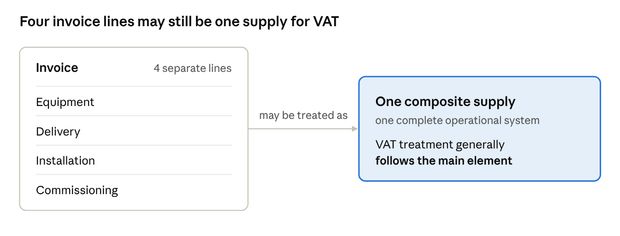
Why this matters. The number of lines on an invoice does not by itself determine the VAT treatment. What matters is the commercial reality of the transaction and what the customer is actually buying. This is particularly relevant for businesses selling bundled goods and services, installation packages, software with implementation, or other integrated solutions.
4. Supplier verification: a valid invoice may no longer be enough
From 1 October 2026, businesses may need to perform additional checks on their suppliers and transactions before claiming input VAT.
Before. VAT recovery was often approached mainly as a documentation exercise, with businesses focusing on whether they held the required documents, including a valid tax invoice.
From 1 October 2026. A valid invoice may not always be enough. Businesses may also need to verify that the supplier is genuine, that the transaction actually took place, and that the supply chain does not raise concerns linked to tax evasion.
If a transaction is connected to tax evasion and the required checks were not carried out, the FTA may challenge or refuse the related VAT recovery. The level of verification required depends partly on the value of the supplies received from the supplier.
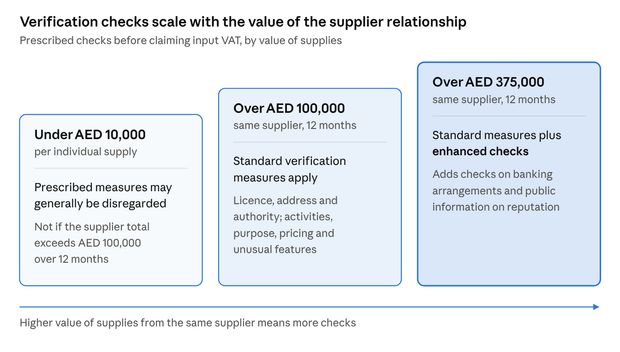
The thresholds look at the whole supplier relationship over 12 months, not only at the individual invoice.
Supplies below AED 10,000
If an individual taxable supply is worth less than AED 10,000 excluding VAT, the prescribed verification measures may generally be disregarded. However, this exception does not apply if total supplies from the same supplier exceed, or are expected to exceed, AED 100,000 over a 12-month period.
Example. A business buys AED 9,000 of services from the same supplier every month. It cannot rely on each individual invoice being below AED 10,000, because the relationship totals AED 108,000 over 12 months, above the AED 100,000 limit.
Supplies above AED 100,000 over 12 months
Once supplies from the same supplier exceed, or are expected to exceed, AED 100,000 over 12 months, standard verification measures apply. These may include checking:
- The supplier
- its incorporation and licence details;
- its registered address and actual place of business;
- the identity and authority of the person acting for it; and
- whether its activities are consistent with the goods or services being provided.
- The transaction
- whether it has a genuine commercial purpose;
- whether the prices, margins and payment terms make commercial sense; and
- whether there are any unusual or suspicious features.
Supplies above AED 375,000 over 12 months
Where supplies from the same supplier exceed, or are expected to exceed, AED 375,000 over 12 months, the standard verification measures still apply, but businesses must also carry out enhanced checks. These include further verification of the supplier’s banking arrangements and a review of publicly available information concerning the supplier and its reputation.
Why this matters. VAT compliance now goes beyond simply collecting the correct invoice. Businesses increasingly need to know who they are dealing with, understand the commercial logic of the transaction, and keep enough information to demonstrate that the required checks were carried out. Finance and procurement teams should therefore review their supplier onboarding and verification procedures.
5. Cross-border services: greater clarity on short stays in the UAE
A foreign client may be physically present in Dubai without automatically being treated as being in the UAE for VAT purposes.
Before. A foreign customer’s temporary presence in the UAE could create uncertainty when deciding whether that customer should be treated as being inside or outside the country.
From 1 October 2026. A person may still be treated as being outside the UAE where they are present in the UAE for less than 30 days and their presence is not effectively connected with the relevant supply.
Example. A foreign client visits Dubai for a few days of meetings while receiving consulting services from a UAE business. That temporary visit does not automatically mean the client must be treated as being in the UAE for VAT purposes.
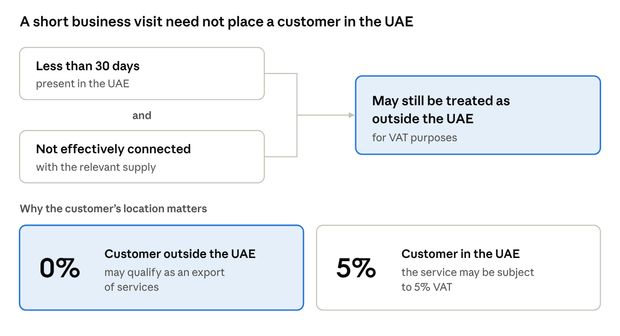
Why this matters. The customer’s location can affect the VAT treatment of the service. In some cases, a service supplied to a customer outside the UAE may qualify for 0% VAT as an export of services, while a service supplied to a customer in the UAE may be subject to 5% VAT. The important question is therefore not only where the customer is physically located, but whether their presence in the UAE is actually connected with the service being supplied.
6. Medical products and healthcare: updated zero-rating rules
The VAT treatment of medical products has been updated, particularly the categories of products that may qualify for zero-rating.
Before. Certain pharmaceutical products and medical equipment could already qualify for 0% VAT where the relevant conditions were satisfied.
From 1 October 2026. The amended rules use the broader concept of “medical products” and align the VAT treatment with the UAE’s updated healthcare legislation. Businesses should check whether products currently treated as zero-rated continue to fall within the relevant categories.
Why does zero-rating matter?
Zero-rating is not the same as exemption. With a zero-rated supply, the business may generally still recover VAT on related costs; with an exempt supply, that VAT may not be recoverable.
Take a simple example. A company sells a qualifying medical product for AED 10,000 and, because the product is zero-rated, the customer pays AED 10,000 with no VAT added. The business has paid AED 400 of VAT on costs connected with selling that product, such as packaging, equipment or professional services.
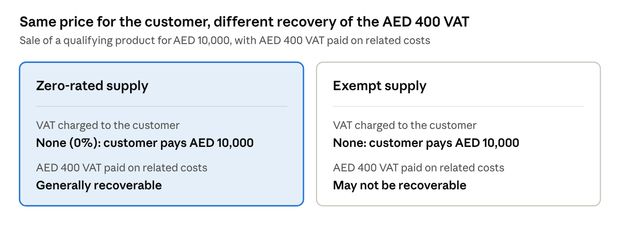
Why this matters. Simply describing a product as “medical” is not enough. Its correct VAT classification can affect both the amount charged to the customer and the amount of VAT the business can recover on its own costs.
7. Profit Margin Scheme: acquisition costs clarified
The amendments clarify how certain acquisition-related costs should be treated under the Profit Margin Scheme. Under this scheme, VAT may in some cases be calculated on the profit made on a sale rather than on the full selling price. For example, if an eligible business buys a second-hand item for AED 100,000 and later sells it for AED 120,000, VAT may be calculated on the AED 20,000 margin rather than on the full AED 120,000.
Before. Certain costs linked to acquiring the goods could already be included in the purchase price used to calculate the margin, but the relationship between those costs and VAT recovery was not completely clear.
From 1 October 2026. Certain acquisition-related costs can be included in the purchase price where the VAT on those costs is not recoverable.
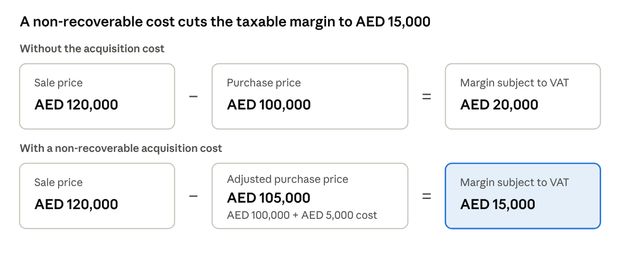
The logic is that if VAT on an acquisition cost cannot be recovered, that cost may increase the purchase price used under the scheme and therefore reduce the taxable margin. If the VAT on the cost has already been recovered, the same cost should not also be used to reduce the margin.
Why this matters. Businesses using the Profit Margin Scheme should review how they treat acquisition-related costs and make sure that the treatment is consistent with their VAT recovery position.
8. Capital Assets Scheme: VAT recovery may change over time
The amendments also clarify the Capital Assets Scheme, which applies to certain high-value business assets and recognises that the way an asset is used may change over time. If a business buys an asset that is used for taxable activities, it may generally recover the VAT paid on that asset, subject to the normal VAT recovery conditions.
Before. The regulation referred to a “single item of expenditure of the business”, which could create uncertainty about whether the rule focused on the expenditure itself or on the underlying asset.
From 1 October 2026. The wording refers more clearly to a business asset costing at least AED 5 million excluding VAT, subject to the relevant useful-life conditions.
The AED 5 million threshold itself is not new. The amendment mainly clarifies what qualifies as a capital asset for the purposes of the scheme.
How does it work?
Imagine that a business buys a commercial property for AED 10 million, plus AED 500,000 VAT.
- At purchase: the property is used entirely for taxable business activities, so the business may generally recover the AED 500,000 VAT.
- A few years later: the property is used 50% for taxable activities and 50% for exempt activities. The business may now need to repay part of the VAT it originally recovered.
For buildings, the Capital Assets Scheme generally monitors the asset over a 10-year adjustment period. If the use of the property changes during that period, the VAT recovery can be adjusted for the relevant year rather than automatically reversing the full amount previously recovered. The mechanism also works in the opposite direction: if an asset becomes more heavily used for taxable activities, the business may be entitled to recover additional VAT.
Why this matters. A business should not assume that the VAT treatment of a major asset is fixed at the date of purchase. High-value property, machinery and other long-term assets should be monitored, because changes in their use can affect VAT recovery over time.
9. Tax Credit Notes: a small but practical correction
A Tax Credit Note is generally issued when a business needs to reduce or correct an amount that was previously invoiced. For example, a company may issue an invoice for AED 10,000 plus AED 500 VAT and later grant the customer an AED 2,000 discount. A Tax Credit Note would then be issued to reduce both the taxable amount and the VAT previously charged.
Before. The VAT Executive Regulation referred to the words “Tax Credit Note” appearing on the “invoice”.
From 1 October 2026. The wording has been corrected: the words “Tax Credit Note” must appear clearly on the credit note itself.
Why this matters. The VAT treatment itself has not changed, but businesses should check that their accounting software and document templates correctly identify these documents as “Tax Credit Note”.
What should UAE businesses do now?
The amendments affect much more than the calculation of VAT and may require changes to internal processes across several departments. Depending on their activities, businesses should review the following.
Recovering input VAT
- Employee accommodation policies: whether accommodation is an employee benefit or legally required by MoHRE, and whether documents support that position.
- Significant cash payments: which supplier payments are made in cash, pending the threshold to be set by Ministerial Decision.
- Supplier onboarding: which suppliers cross AED 100,000 or AED 375,000 over 12 months, and whether the checks are carried out and recorded.
How supplies are treated
- Bundled supplies: whether invoices with several lines are, in commercial reality, one composite supply.
- Cross-border service arrangements: whether a visiting foreign customer’s presence is under 30 days and unconnected with the supply.
- Medical-product classifications: whether products treated as zero-rated still fall within the updated categories.
Schemes and documents
- Profit Margin Scheme calculations: whether acquisition costs are added to the purchase price only where their VAT is not recovered.
- Capital Assets Scheme records: whether changes in the use of assets of AED 5 million or more are monitored over the adjustment period.
- Tax Credit Note templates: whether software and templates show “Tax Credit Note” on the credit note itself.
Businesses should also continue to monitor the Ministry of Finance for the forthcoming decision setting the cash-payment threshold, as this will determine the practical scope of the new restriction on VAT recovery for high-value cash payments.
Conclusion
The UAE VAT rate remains unchanged, but the rules surrounding VAT recovery and compliance have become more detailed. Businesses now need to pay closer attention not only to their invoices and VAT calculations, but also to the commercial substance of transactions, the way suppliers are verified, the way payments are made, and the documents kept to support the VAT treatment adopted.
The changes effective from 1 October 2026 are therefore a good opportunity for UAE businesses to review their existing VAT procedures and make sure that finance, procurement, HR and accounting processes remain aligned with the updated framework.
Looking ahead. The amendments also introduce a revised input VAT apportionment methodology for businesses carrying out both taxable and exempt activities. Unlike most of the changes discussed above, this new methodology will only apply from the first Tax Year commencing after 1 October 2027.
Disclaimer: This article is provided for general information purposes only and does not constitute legal, tax or professional advice. The application of UAE VAT rules depends on the specific facts and circumstances of each case. Businesses should obtain appropriate professional advice before taking or refraining from any action based on the matters discussed in this article. Legislation, regulations and administrative guidance may also change over time.
Questions about an article? Talk to us.